
Last updated: 2026-08-26 · 12 min read · by Golden Eagle Engineering
Etching Machine for Precision Filters & Filter Meshes (10–500 μm Aperture)
Precision filter etching uses photochemical milling (PCM) to produce stainless steel, copper, and nickel filter meshes with controlled aperture (10-500 μm) and tight tolerance (±5 μm). This page covers the process, equipment selection, applications across hydraulic, fuel, medical, and battery filtration, and the trade-offs vs woven/welded mesh and sintered metal.
Why Chemical Etching for Precision Filters?
For aperture sizes between 10 and 500 μm, chemical etching (also called photochemical milling or PCM) outperforms alternatives:
- vs Woven mesh: Edched mesh has perfectly round/square apertures with no fraying; woven mesh has irregular openings and breaks at bends.
- vs Sintered mesh: Lower cost, thinner sheet (0.05-0.5 mm), no clogging risk, better flow rate.
- vs Laser: Laser minimum aperture is 50-100 μm; chemical etching reliably hits 25 μm. No heat-affected zone; no slag.
- vs Electroforming: Etching is 5-10× faster and works on thicker sheets (up to 1.0 mm).
Photochemical Milling (PCM) Process for Filter Mesh
- Material selection. Stainless steel (304/316), copper, brass, or nickel sheet, 0.05-1.0 mm thick.
- Surface prep & lamination. Clean sheet → laminate dry film photoresist (25-50 μm) at 105-115°C. For ultra-fine features (<50 μm), use liquid photoresist.
- Exposure. Expose through the artwork film using collimated UV light source. Resolution: 25-50 μm features achievable.
- Develop. 1% Na2CO3 at 30°C for 30-60 sec. Quality check: open apertures should be clean.
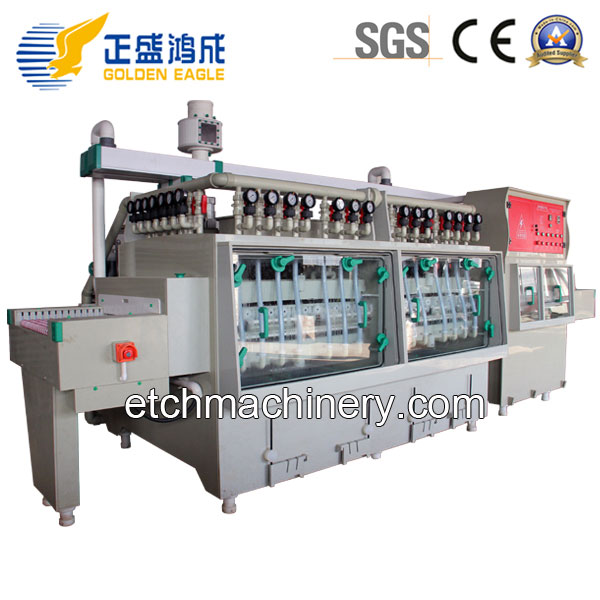
- Etch. Ferric chloride (FeCl3, 38-42°Bé) at 45-50°C with 1-2 bar spray pressure. Etch time depends on sheet thickness (15-30 min for 0.3-0.5 mm).
- Strip & inspect. Remove resist → rinse → dry → 100% inspection under microscope for aperture tolerance.
Filter Mesh Specification Reference
| Aperture | Application | Common Material | Sheet Thickness |
|---|---|---|---|
| 10-25 μm | Lab filters, microfluidics, fuel cell GDL | 304 SS, Nickel | 0.05-0.10 mm |
| 25-50 μm | Coffee filters, hydraulic filters, IV filters | 304 SS, 316L | 0.10-0.20 mm |
| 50-100 μm | Fuel injectors, air filters, sensor mesh | 304 SS, 316L, Brass | 0.15-0.30 mm |
| 100-300 μm | Industrial screens, food processing, sieves | 304 SS, Copper | 0.20-0.50 mm |
| 300-500 μm | Coarse screens, mining, drainage | 304 SS, Mild steel | 0.30-1.00 mm |
Sample Gallery — Precision Filter Mesh Etching
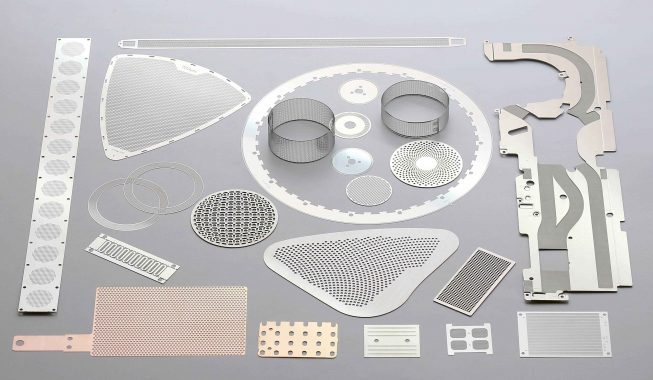
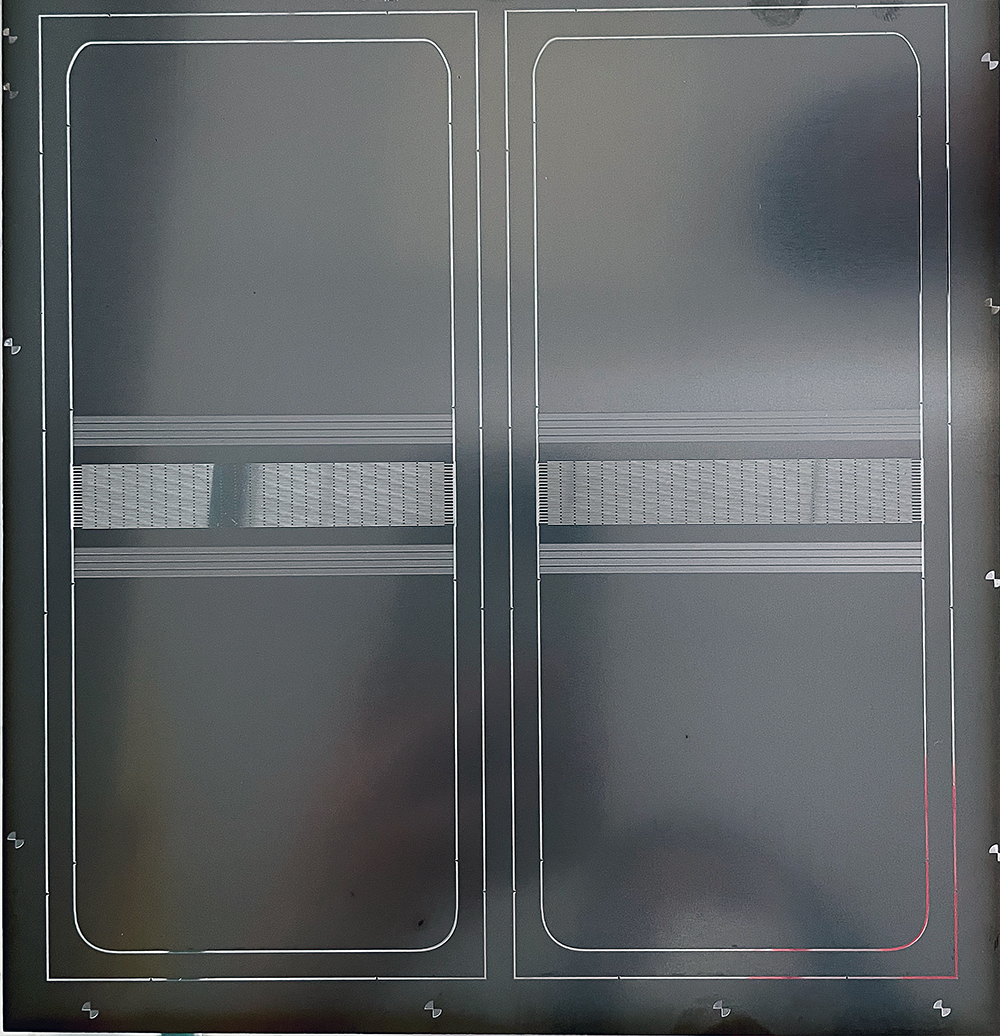
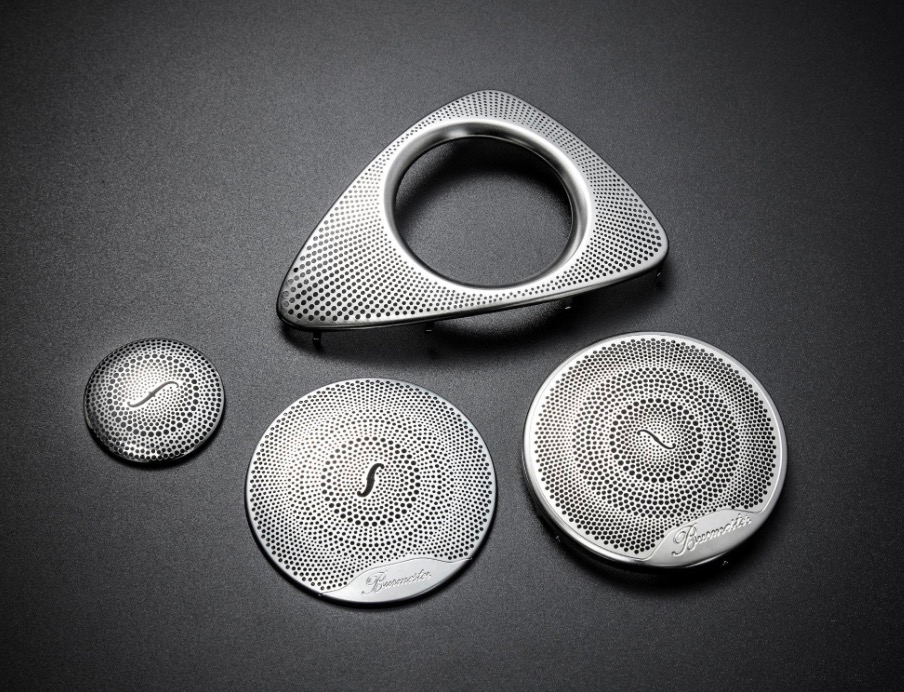
Real production samples from our precision filter etching lines. Apertures from 25 µm to 500 µm on stainless steel, titanium, copper, and nickel substrates.

Recommended Equipment
For precision filter etching, we recommend wide-format photochemical milling lines (GE-SK9 series) with ±5 μm aperture tolerance. Smaller labs use GE-FET500 or GE-S650.
| Model | Working Width | Best Aperture Range | Price (USD) |
|---|---|---|---|
| GE-FET500 | 500×600 mm | 25-500 μm (R&D) | From $5,000 |
| GE-S650 | 650 mm | 50-500 μm | From $5,500 |
| GE-SK9 | 650-2,500 mm | 25-300 μm (production) | From $9,800 |
Need Precision Filter Mesh Production?
Tell us your aperture size, material, sheet thickness, and monthly volume. We will recommend the right photochemical milling line and quote within 24 hours.
Request Filter Etching Quotation →Frequently Asked Questions
What is the smallest aperture achievable by chemical etching?
Standard photochemical milling (PCM) achieves 25-50 μm apertures reliably on 0.10-0.20 mm sheet. With optimized process, fine-grain photoresist, and collimated UV, 10-15 μm apertures are achievable on thin nickel or stainless sheet (<0.10 mm). Below 10 μm, electroforming becomes the preferred method.
What tolerance can chemical etching achieve for filter mesh?
Standard tolerance: ±10% of nominal aperture, or ±5 μm (whichever is larger). For example, a 100 μm aperture has ±10 μm tolerance; a 50 μm aperture has ±5 μm tolerance. With tight process control, ±2 μm is achievable on thin sheet for critical applications.
Stainless steel vs copper vs nickel for filter mesh — which to choose?
Stainless steel (304/316L) is the most common — corrosion-resistant, durable, food-grade compatible. Copper is cheaper and easier to etch but oxidizes. Nickel is the premium choice for alkaline battery separators and hydrogen applications — expensive but stable at high temperature. Choose based on fluid compatibility, temperature, and cost.
What thickness of stainless steel for filter mesh?
Typical 0.10-0.50 mm. For aperture <50 μm, use 0.05-0.15 mm sheet. For 100-300 μm apertures, 0.20-0.40 mm. For coarse screens (>500 μm), 0.50-1.0 mm. Sheet thickness must be selected based on mechanical strength requirement of the application.
What is the difference between etching and electroforming for filter mesh?
Etching removes material from a solid sheet; electroforming builds up metal on a mandrel. Etching is faster, cheaper, and works on thicker sheets. Electroforming produces smoother walls and tighter tolerance on very fine apertures (5-25 μm). Choose etching for 25+ μm apertures and high-volume production; choose electroforming for ultra-fine mesh and small batches.
Can chemical etching produce 3D filter structures?
No. Chemical etching is 2D only — it produces through-holes or recesses. For 3D filter structures (graduated porosity, depth-graded mesh), use laser drilling followed by etching, or sintered mesh. For depth-graded mesh, multiple exposures with different photoresist thicknesses can create stepped etch depths.
How much does a precision filter mesh etching line cost?
Lab-scale: GE-FET500 from $5,000 USD. Small-batch: GE-S650 from $5,500 USD. Production: GE-SK9 wide-format from $9,800 USD (supports 650-2500 mm width). Complete photochemical milling line with artwork generation, exposure, etching, and inspection: $25,000-$80,000 USD.
Related Articles & Equipment
- → Filter Mesh Chemical Milling Machine (product page)
- → Ferric Chloride Etching Machine
- → Industrial Etching Equipment Comparison
- → Blog: Etching Machine for Filter Mesh
Mentioned in These Articles
This equipment is referenced in the following Golden Eagle technical guides: