
Stainless Steel Etching Machine Buyer's Guide 2026
A stainless steel etching machine is a conveyor spray or immersion line that uses ferric chloride (FeCl3) at 40–50 °C to dissolve selectively-masked 304 / 316 / 430 stainless sheet, producing burr-free nameplates, sign panels, filter meshes and bipolar plates at ±0.02–0.05 mm tolerance. Prices in 2026 run from $5,000 USD for a 500 mm lab etcher (Golden Eagle GE-FET500) to $45,000 USD for a wide-format multi-chamber line (GE-SK9), with the GE-S650 and GE-JM650 covering 90% of small and mid-volume stainless production.
Quick Answer
- Match the machine to your part, not the other way around. Nameplate and signage shops under 200 plates/day need a 500–650 mm conveyor (GE-S650 / GE-JM650, USD 5,500–8,500). Decorative panel or fuel-cell plate producers need wide-format ≥1,500 mm (GE-SK9, USD 9,800+).
- Ferric chloride at 40–50 °C is the workhorse etchant for 304 and 316 stainless. Reject any quote that recommends CuCl2 for stainless — copper will plate out on the chrome-rich surface.
- Look for ±0.02 mm precision, dual-side spray, 25–40 µm/min etch rate, PLC temperature control, polypropylene or PVDF chamber construction, and a documented install base — not just CE stickers.
- Total cost of ownership (chemistry + energy + spares) over 5 years usually equals the purchase price. A USD 5,500 conveyor spray line with low chemistry consumption beats a USD 4,500 immersion bath in TCO within 18 months.
Table of Contents
- Who This Buyer's Guide Is For
- The 9 Specifications That Actually Matter
- Model Comparison: 4 Golden Eagle Stainless Steel Etchers
- Which Model Fits Your Application?
- Chemistry: Why FeCl3 Wins for Stainless Steel
- Total Cost of Ownership: A Worked Example
- Supplier Checklist: 6 Questions Before You Pay
- 7 Common Mistakes When Buying a Stainless Etcher
- Installation, Commissioning & Operator Training
- Conclusion
- Frequently Asked Questions
Who This Buyer's Guide Is For
This guide is for plant managers, production engineers, and procurement leads at companies that etch stainless steel — or plan to. Typical buyers in 2026 fall into one of three groups:
- Nameplate & signage shops — 50 to 5,000 plates/day, 304/316 grade, 0.3–1.5 mm thickness, mostly text and logo work at ±0.05 mm tolerance.
- Decorative panel producers — elevator panels, architectural cladding, kitchen equipment faces. 1,219×2,438 mm (4'×8') sheets, 0.6–1.2 mm, often two-sided and colour-filled after etch.
- Filter mesh & bipolar plate manufacturers — fine apertures 25–500 µm, ±0.02 mm tolerance, often 316L for chemical compatibility.
Each group needs different things from an etching line. A 200-plate/day nameplate shop that buys a USD 60,000 wide-format photochemical milling line has wasted USD 50,000. A fuel-cell plate maker that buys a USD 5,000 fume-hood etcher will fail to hit tolerance on day one. This guide helps you land in the right window.

Stainless Steel Etched Products — Real-World Examples
Sample parts produced by Golden Eagle stainless steel etching lines across the major application sectors:
-
 Filter Mesh
Stainless Steel Filter Mesh
25–500 µm apertures, ±0.02 mm tolerance
-
 Nameplate
Stainless Steel Nameplate
304/316 grade, 0.3–1.5 mm thickness
-
 Signage
Stainless Steel Sign & Plaque
Permanent outdoor branding
-
 Decorative Panel
Stainless Steel Decorative Sheet
Architectural & elevator panels, 4'×8'
-
 Mirror Finish
PVD Gold Mirror Stainless Sheet
Premium interior decoration
-
 Signage
Etched Wayfinding Signage
High-contrast permanent graphics
-
 Art Panel
Etched Stainless Steel Art Panel
Custom decorative prints
-
 Precision Label
Photo-Etched Stainless Label
Fine detail for electronics & medical
-
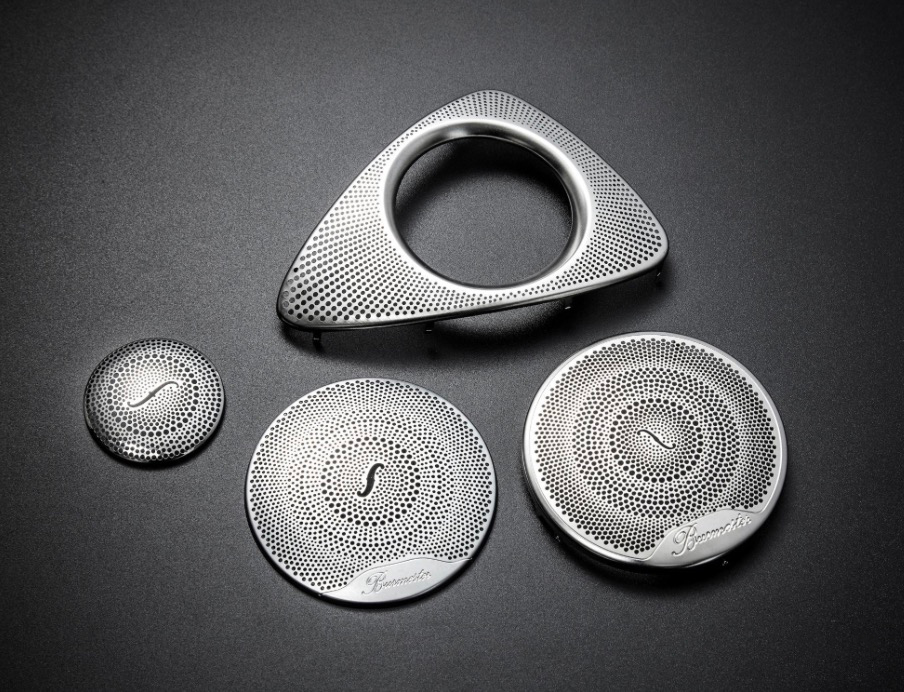 Grilles
Etched Speaker Grilles
Precision micro-perforation
The 9 Specifications That Actually Matter
Quotation sheets from etching machine suppliers run 20 to 30 lines long. Most of those lines don't matter for stainless steel work. After two decades of building etchers for nameplate, signage, filter and bipolar-plate shops, we've narrowed it down to 9 specifications that drive whether your line will run cleanly at your required tolerance and throughput. Use this checklist against every quote.
1. Working width (conveyor width or bath size)
Match this to your widest sheet. A 650 mm conveyor covers ~95% of nameplate and signage work; if you process full 4'×8' (1,219×2,438 mm) sheets you need a 1,300–2,500 mm wide-format line like the GE-SK9. Wider costs more in chemistry tank volume, exhaust capacity, and floor space — so don't over-buy.
2. Conveyor speed range
0.3 to 6 m/min covers most stainless work. Speed drives residence time and therefore etch depth. PLC-controlled variable speed (not just stepped gears) lets you tune for different grades and thicknesses.
3. Etch rate on stainless
Ask for the rate on 304 stainless at 45 °C, not on copper. Real production rates: ferric chloride gives 25–40 µm/min on 304, 20–30 µm/min on 316 (the Mo slows it). Anything quoted above 50 µm/min is suspect — usually the supplier tested on copper.
4. Etch precision / line-width tolerance
Standard conveyor spray etchers from Golden Eagle hold ±0.02 to ±0.03 mm. ±0.05 mm is acceptable for general nameplates, ±0.02 mm is required for filter mesh and bipolar plates. Anything looser than ±0.05 mm is an old immersion bath — avoid it for new production.
5. Sidewall taper
Dual-side spray calibration keeps sidewall taper ≤5°. Single-side spray drifts to 8–12° on 1.5 mm sheet, which matters when two etched faces mate (bipolar plates, RF shields). Ask the supplier to demonstrate or provide a sample.
6. Chamber / tank material
PP (polypropylene) for ferric chloride up to 60 °C. PVDF if you also plan to use HCl/HF blends for 17-4 PH or 430. PVC is too thin for hot FeCl3; FRP is fine for cold baths but degrades fast above 50 °C. Stainless tank bodies must be PP-lined or PVDF-lined — bare 304 tanks will corrode within months.
7. Temperature control accuracy
±1 °C is the minimum. ±0.5 °C is preferred for tight tolerance. Anything less and your etch rate drifts 5–8% per degree, which translates directly into inconsistent etch depth across a batch.
8. Spray pressure and nozzle configuration
1–3 kg/cm² spray pressure with full-cone nozzles, oscillation or spray-rod pattern. Pressure that's adjustable per zone lets you optimise etch uniformity along the conveyor.
9. Throughput in panels/hour or m²/hour
Always normalise to your part. A line quoted at "300 panels/hour" is meaningless if your panels are 100×100 mm and theirs are 50×50 mm. Ask for the throughput at your panel size and your target etch depth — the supplier should be able to calculate it.
The Stainless-Steel Etching Specification Scorecard
Before you accept a quote, score each candidate on these 9 items. A "yes" on all 9 is the threshold for serious production work.
- ☑ Working width matches your widest sheet (no more than 1.5× needed)
- ☑ Conveyor speed 0.3–6 m/min, PLC-controlled variable
- ☑ Etch rate ≥25 µm/min on 304 stainless at 45 °C
- ☑ Tolerance ±0.03 mm or better
- ☑ Sidewall taper ≤5°
- ☑ Tank material PP or PVDF (not bare stainless)
- ☑ Temperature control ±1 °C or better
- ☑ Adjustable spray pressure with full-cone nozzles
- ☑ Documented throughput at your panel size
Model Comparison: 4 Golden Eagle Stainless Steel Etchers
Below is a side-by-side of the 4 Golden Eagle models most often quoted for stainless steel etching. All prices are 2026 indicative EXW Beijing, include English manual, 12-month warranty, CE Technical File, FOB packing, and a process recipe book for 304 / 316 / 430 grades.
| Specification | GE-FET500 | GE-S650 | GE-JM650 | GE-SK9 |
|---|---|---|---|---|
| Type | Lab / fume hood | Conveyor spray | Conveyor spray (most popular) | Wide-format PCM |
| Working width | 500×600 mm | 650 mm | 650 mm | 650–2,500 mm |
| Chemistry | FeCl3 | FeCl3 / Acidic | FeCl3 / CuCl2 / Alkaline | FeCl3 / CuCl2 |
| Etch rate (304 SS) | 15–25 µm/min | 25–35 µm/min | 30–40 µm/min | 30–45 µm/min |
| Tolerance | ±0.05 mm | ±0.03 mm | ±0.02 mm (50 µm min) | ±0.02 mm |
| Throughput | 20–40 plates/hr | 80–250 plates/hr | 100–300 plates/hr | 120–350 plates/hr |
| Tank material | PP | PP | PP + PVDF option | PP + PVDF option |
| Best for | Prototype, lab, sample shop | Nameplate, signage shops | Filters, precision nameplates, mid-volume signage | Architectural panels, bipolar plates, full 4'×8' sheets |
| Indicative price (2026) | USD 5,000 | USD 5,500 | USD 8,500 | USD 9,800+ |
The GE-JM650 is the model we sell most often for stainless work — it hits the 90/10 spot between capability and price, supports all three common etchants, and runs the precision filter shops need. The GE-SK9 wide-format line is what bipolar-plate and architectural-panel buyers move up to once volume justifies it.
Which Model Fits Your Application?
Use this decision tree to narrow down quickly. If you answer "yes" to more than one of these, pick the model that covers the toughest requirement.
You're making 50–200 nameplates per day, mostly 304 grade, under 1.5 mm thick
→ GE-S650 (USD 5,500). Cheapest viable conveyor spray line. ±0.03 mm tolerance covers nameplate and signage work. Skip the GE-FET500 unless you really only do lab samples.
You're making filter meshes or signs with line widths below 100 µm
→ GE-JM650 (USD 8,500). The 50 µm minimum feature size and the option to run alkaline chemistry on fine 316L mesh make this the right floor for precision work.
You're etching full 4'×8' decorative panels or bipolar plates
→ GE-SK9 (USD 9,800 base, scales with width). The 1,300–2,500 mm working width means no sheet splicing, which saves 2–4 hours of cycle time per panel.
You're a university lab or R&D team making 5–20 samples per week
→ GE-FET500 (USD 5,000). Sits in a fume hood, no conveyor needed. Same chemistry as the production lines so process recipes transfer directly when you scale up.
You're scaling a nameplate shop past 5,000 plates/day
You're past single-line territory. Look at a DES (Developing–Etching–Stripping) integrated line starting at USD 25,000, or talk to us about a multi-line layout with shared regeneration and wastewater treatment.
Chemistry: Why FeCl3 Wins for Stainless Steel
For austenitic 304 and 316 stainless — the grades that make up 90% of etched stainless parts — ferric chloride (FeCl3) is the default etchant. At 38–42 °Bé and 40–50 °C, it etches at 25–40 µm/min, gives clean sidewalls, costs USD 1–2 per litre, and neutralises with lime to a settled iron hydroxide sludge that's standard to dispose of.
The two common alternative chemistries have specific downsides for stainless:
- Cupric chloride (CuCl2) — excellent on copper and copper-clad PCB, but on stainless it deposits a copper film on the chrome-rich surface, ruining the finish. Don't use CuCl2 for stainless even if a supplier recommends it because their line is configured for it.
- Alkaline ammonia (NH4Cl / NH4OH) — works on stainless but is slow (10–20 µm/min) and the ammonia fumes require more aggressive exhaust. Reserved for HDI PCB and fine-feature work where the alkaline chemistry's lower undercut matters more than throughput.
For 17-4 PH, 410, or 430 ferritic grades with very high chromium content, an HCl/HF blend or a pre-passivation step is sometimes needed. The GE-JM650 and GE-SK9 both accept PVDF-lined chambers for HF chemistry — make sure to specify this if you plan to etch those grades.
Total Cost of Ownership: A Worked Example
The purchase price is the smallest line on a 5-year cost statement for an etching line. Most shops are surprised at how much chemistry, energy, and consumables add up. Here is a worked example for a mid-volume stainless nameplate shop running one GE-JM650 for 5 years.
| Cost line | Year 1 | Years 2–5 (each) | 5-year total |
|---|---|---|---|
| Machine purchase (EXW Beijing, including commissioning) | USD 8,500 | — | USD 8,500 |
| Freight + customs + on-site install | USD 2,800 | — | USD 2,800 |
| FeCl3 etchant (1,200 L/yr at USD 1.40/L) | USD 1,680 | USD 1,680 | USD 8,400 |
| Sodium hydroxide for neutralisation | USD 320 | USD 320 | USD 1,600 |
| Energy (heaters + exhaust + pumps, ~12 kW continuous) | USD 3,800 | USD 3,800 | USD 18,800 |
| Spare parts (pumps, nozzles, seals — typical PM) | USD 600 | USD 600 | USD 3,000 |
| Wastewater treatment consumables | USD 1,200 | USD 1,200 | USD 6,000 |
| Labour (1 operator, 25% of time on this line) | USD 4,000 | USD 4,000 | USD 20,000 |
| 5-year TCO | USD 22,900 | USD 11,600/yr | USD 69,100 |
Notice that the machine purchase is only ~12% of the 5-year cost. A USD 1,000 saving on the machine that costs USD 3,000/year more in chemistry and energy is a bad trade. Use this kind of breakdown on every quote — most suppliers will help you build it if you ask.
TCO Takeaways
- The machine price is small relative to operating cost. Buy on TCO, not on capex.
- Energy + wastewater together exceed the machine cost over 5 years. A more efficient line pays for itself.
- Labour is the single biggest line. Easy-to-use PLC controls and quick-change cassette nozzles cut operator time and reduce training cost.
- Chemistry cost scales with throughput. Conveyor spray uses 30–50% less chemistry than immersion at the same output, which is why conveyor spray wins at volume.
Supplier Checklist: 6 Questions Before You Pay
Stainless steel etching machines range from USD 5,000 to USD 200,000+ from very different suppliers. The hard part isn't picking the spec — it's picking a supplier who will still answer the phone 3 years later when a pump seal fails. Six questions separate the serious manufacturers from the brokers:
1. How long have you been making etching machines continuously?
Anything under 10 years is high risk. Golden Eagle has been making etching equipment since 2003 — over two decades of continuous production, three product generations, and a few thousand installed lines. A newer supplier may be cheaper but you'll be the line that finds their bugs.
2. Can I see your CE Technical File, not just a CE sticker?
The CE mark on a Chinese machine is only as good as the technical file behind it. Ask for the Declaration of Conformity, the risk assessment, and the test reports for the model you're buying. A serious supplier sends these within 48 hours without fuss.
3. Who have you shipped to, and can I phone one of them?
A reference list with company names, cities, and phone numbers (with the customer's permission) is gold. If the supplier only sends PDF brochures with no verifiable references, treat that as a yellow flag.
4. What process recipes come with the machine?
A good supplier ships at least 3 stainless recipes — typically 304, 316, and 430 — with documented temperature, concentration, time, and expected etch depth. Golden Eagle ships a 12-recipe booklet covering 304, 304L, 316, 316L, 430, 17-4 PH, plus the common copper and brass chemistries.
5. How fast can you commission on-site or remotely?
For Asian customers: 72 hours. For Europe / Americas: 5 working days for on-site, immediate for remote commissioning (with English-speaking engineer on video). Anything slower is a service problem waiting to happen.
6. What's your warranty and spare-parts commitment?
Standard for serious suppliers: 12-month warranty on the whole machine, 24-month on electronics, 10-year spare-parts supply guarantee in writing. We've shipped spare parts to lines we built in 2007. Anything less is a sign the supplier doesn't expect to be around.
7 Common Mistakes When Buying a Stainless Etcher
These are the mistakes we see most often from first-time buyers. Each one of them costs a working week of production and a meaningful chunk of change.
Mistake 1: Buying on capex, not TCO
The cheapest quote is rarely the cheapest line over 5 years. Chemistry consumption, energy efficiency, and spare-part pricing drive 80%+ of operating cost. Always score on TCO.
Mistake 2: Over-specifying the working width
A 2,500 mm line costs ~3× the chemistry tank, exhaust, and floor space of a 650 mm line. If your widest sheet is 600 mm, you don't need 2,500 mm. Conversely, if your widest sheet is 1,200 mm, a 650 mm line forces sheet splicing and ruins throughput.
Mistake 3: Choosing CuCl2 for stainless because the supplier recommended it
CuCl2 deposits copper on stainless. Always confirm FeCl3 or an HCl/HF blend is specified for stainless work. A CuCl2-configured line will produce scrap on day one.
Mistake 4: Skipping the on-site or remote commissioning
Even experienced teams lose a week if they commission a new line themselves. Pay for the supplier's commissioning engineer — it's 3–5% of the machine price and pays for itself in the first month.
Mistake 5: Ignoring wastewater treatment in the planning stage
A stainless etching line generates iron-hydroxide-laden wastewater. Local discharge limits vary widely (EU Directive 2008/105/EC, US EPA 40 CFR 433, China GB 21900-2008). Plan the wastewater skid at the same time as the etching line, not after.
Mistake 6: Underestimating ventilation requirements
FeCl3 fumes are corrosive and unpleasant. Plan for 15–25 air changes per hour in the etch room, with PVC ducting and a packed-bed scrubber on the exhaust. Skimping here is a health-and-safety issue, not just an equipment issue.
Mistake 7: Not budgeting for chemistry and spare-part inventory
First FeCl3 delivery + neutralisation chemicals + 12 months of spare parts (pump seals, nozzles, gaskets, level sensors) typically add USD 2,500–4,500 to the project. Include this in your purchase order, not as an afterthought.
Installation, Commissioning & Operator Training
A stainless etching line typically takes 5–7 working days from delivery to first good part. The sequence looks like this:
- Site prep — floor levelled, exhaust ducting in place, 3-phase power to the machine, water supply with backflow preventer, drainage to wastewater skid. Done before the machine arrives.
- Mechanical install — line positioned, levelled, tank-to-tank piping connected. 1 day with 2 technicians.
- Electrical & controls — PLC, VFDs, temperature controllers, level sensors wired and tested. 1 day.
- Wet commissioning — tanks filled with water (not chemistry yet), pumps primed, nozzles tested for even spray pattern. 1 day.
- Chemistry commissioning — FeCl3 loaded at target °Bé, first 304 stainless sample sheet run end-to-end. 1 day.
- Calibration & recipe tuning — etch depth, sidewall taper, undercut measured against target. 1 day.
- Operator training — 4 hours of classroom + 4 hours of hands-on for your operators. Final day.
Golden Eagle dispatches a commissioning engineer within 72 hours for customers in Asia and within 5 working days for Europe and the Americas. Remote commissioning (over video, with a Golden Eagle engineer on call) is available for customers who prefer to handle mechanical install with their own team.
Conclusion
Choosing a stainless steel etching machine is mostly about being honest about three numbers: your widest sheet, your daily volume, and your tightest tolerance. Once those three are nailed down, the decision usually falls out:
- Under 200 plates/day, <1.5 mm sheet, ±0.03 mm tolerance → GE-S650 at USD 5,500.
- Filters, fine signs, or any work under 100 µm feature size → GE-JM650 at USD 8,500.
- Full 4'×8' panels, bipolar plates, or architectural → GE-SK9 from USD 9,800.
- Lab, R&D, sample shop → GE-FET500 at USD 5,000.
For each model, verify the 9 specifications in the scorecard above, run a TCO calculation over 5 years, and run the supplier through the 6-question checklist before paying. If you do those three things, you will land on the right machine and the right partner.
Tell us your widest sheet, your daily volume, and your tightest tolerance, and our engineering team will recommend a configuration and quote you within 24 hours.
Get a Stainless Steel Etching Quotation in 24 Hours
Send your widest sheet size, daily volume, grade (304 / 316 / 430), and target tolerance. We'll respond with a recommended model, indicative price, and lead time within one business day.
Request Quotation Now →Frequently Asked Questions
What is the best stainless steel etching machine for a small nameplate shop?
For 50–200 plates/day, the Golden Eagle GE-FET500 (USD 5,000) or GE-S650 (USD 5,500) is the right starting point. Both use FeCl3 at 40–50 °C, reach ±0.03 mm, and pass through a standard 1 m door. Move to GE-JM650 (USD 8,500) only when fine filters or sub-100 µm features appear in your mix.
What etchant should I use for stainless steel — FeCl3 or another chemistry?
Ferric chloride (FeCl3, 38–42 °Bé) is the workhorse etchant for austenitic 304 and 316 stainless steel in 90% of nameplate, signage and decorative applications. It etches at 25–40 µm/min at 40–50 °C, gives excellent sidewall control, and is regenerated or neutralised cheaply. For 17-4 PH, 410, or 430 grades with very high chromium, an HCl/HF blend may be needed. Avoid CuCl2 for stainless — copper deposits on the chrome-rich surface and ruins the finish.
What tolerance can a modern stainless steel etching machine hold?
Standard Golden Eagle conveyor spray etchers (GE-S650 / GE-JM650 / GE-SK9) hold ±0.02 to ±0.03 mm line-width tolerance on 0.3–1.5 mm stainless sheet, with minimum feature sizes of 50–100 µm depending on photoresist. Sidewall taper is controlled to ≤5° through dual-side spray calibration. Sub-50 µm features (encoder discs, RF shields) require photochemical milling with the GE-SK9 wide-format line.
How much does a stainless steel etching machine cost in 2026?
2026 prices run from USD 5,000 (GE-FET500 lab/fume-hood etcher) to USD 45,000 (wide-format multi-chamber DES line). Mid-range conveyor spray etchers (GE-S650, GE-JM650) run USD 5,500–8,500 EXW Beijing, including English manual, 12-month warranty, CE Technical File, and FOB packing. Turnkey PCB etching lines with pre-treatment, post-treatment, and wastewater treatment start around USD 50,000 and exceed USD 200,000 for full PCB factories.
How do I pick a reliable stainless steel etching machine supplier?
Check six things: (1) at least 10 years in continuous etching-machine manufacturing; (2) verifiable export volume and CE Technical File, not just a CE sticker; (3) an installed-base reference list with names you can phone; (4) written process recipes for at least three stainless grades (304, 316, 430); (5) on-site or remote commissioning support within 72 hours; (6) a 12-month warranty and 10-year spare-parts supply commitment. Quote-only brokers who can't answer chemistry questions are a red flag.
Is conveyor spray etching better than immersion etching for stainless steel?
For stainless steel at production volume, conveyor spray etching is the industry standard — faster etch rate (25–40 µm/min vs 10–20 µm/min for immersion), better sidewall control, and 30–50% lower chemistry consumption because fresh etchant is constantly delivered to the surface. Immersion is reserved for prototype work, delicate 3D parts that can't be sprayed, or R&D labs. A conveyor line pays for itself in chemistry savings within 12 months once you scale past 200 plates/day.
Related Stainless Steel Etching Equipment
Production equipment used for the stainless steel etching workflows described above:
-
 Etching
Stainless Steel Etching Machine
GE-JM650 / GE-SK9 conveyor spray
-
 Nameplate
Stainless Nameplate Etching Machine
Acid spray, ±0.03 mm tolerance
-
 Decorative
 Stainless Steel Etching Machine
Architectural panels, 1,219×2,438 mm
-
 Regeneration
Etchant Regeneration System
Cuts chemistry cost 40–60%
-
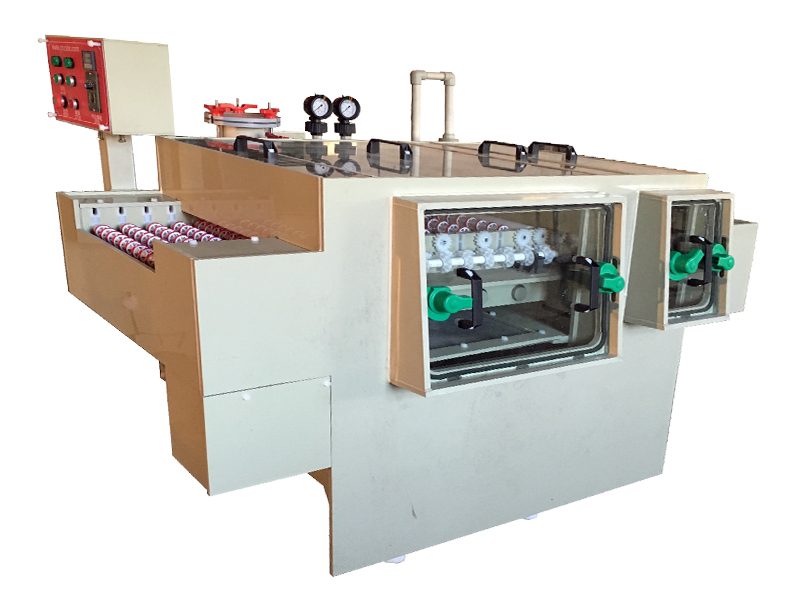 Developing
PCB Developing Machine
GE-D650W sodium carbonate spray
-
 Exposure
LED UV Exposure Machine
GE-LED series, 365-405 nm